


Utilizing Microorganisms
We identify “core microorganisms” that are compatible with crops.
We analyzed and visualized the soil ecosystem of each crop.
We illustrated beneficial/harmful bacteria common across crops.


Soil ecosystem network
for each crop

Core microorganisms
shared among crops
Plant-Associated Fungi
Plant-Pathogenic Fungi
Other Fungi

✤We collected over 6,000 soil samples from farmlands across Japan and analyzed their microbial communities.
We possess data on 19 crop varieties and over 30,000 microbial species.
✤We maintain over 3,000 strains of cultured core symbiotic microorganisms.
Proposal for an Agricultural Ecosystem Management Plan Using Core Symbiotic Microorganisms to Achieve Both Productivity Enhancement and Sustainability.
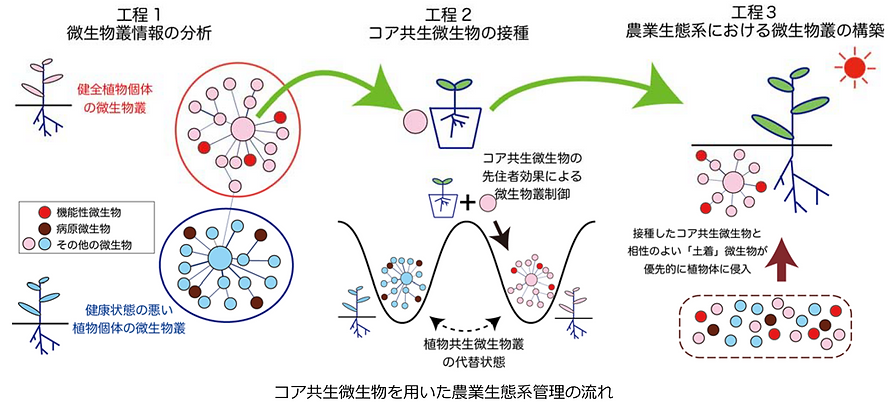
✤ We develop or support the development of biological resources essential for reconstructing agricultural ecosystems.
✤ Our developed biological resources have proven growth-promoting effects on leeks, tomatoes, strawberries, rice, broadleaf and coniferous trees, and ornamental shrubs.
✤ We hold patents for technologies related to analyzing core symbiotic microorganisms and manufacturing materials.
Reconstructing Soil and Vegetation Bases Using Core Symbiotic Microorganisms
✤ We extract core symbiotic microorganisms from forest soil and utilize them as resources.

✤ The activity of core microorganisms promotes the growth of planted seedlings.
Hardwood cutting test
A: No core microorganism inoculation
B: Core microorganism inoculation

A
B
✤ Technology for Rapid Greening of Landslide-Affected Areas
We form soil by utilizing ecosystem resources rooted in that land.
This involves transplanting “soil blocks” or “protected tree blocks” to the center of bare ground to form an “island.”

Once "islands" of established seedlings are formed, symbiotic fungi are supplied to bare forest areas, accelerating seedling colonization in a domino-like fashion.
